
Collecting basics
How to read a Pokémon card, from the name to the card number
Every Pokémon card follows the same layout: name, HP and type at the top, abilities and attacks in the middle, weakness, resistance and retreat cost below, and a strip of small print at the bottom with the regulation mark, set code, card number and rarity. Players use the top half; collectors live in the bottom strip, because it tells you exactly which card you have and which price applies.
The layout at a glance
Pokémon cards have kept the same basic layout for decades. The top half is for the game: who the Pokémon is, how tough it is and what it does. The bottom strip is for collectors: which set the card comes from, where it sits in that set and how rare it is. Read both and you can pin down the exact card, and the exact price, in a few seconds.
The examples in this guide are the three cards below: Pikachu ex 247/191 from Surging Sparks, and two prints of Mega Rayquaza ex from Delta Reign that share the same game text but not the same number, rarity or price.
 Pikachu exSurging Sparks · 247/191$66.90
 Mega Rayquaza exDelta Reign · 084/103$7.39
 Mega Rayquaza exDelta Reign · 138/103$312.70
The top: name, stage, HP and type
- Name. The Pokémon's name, plus a suffix when the card follows special rules: ex on current cards, and EX, GX, V, VMAX or VSTAR on older generations. Mega Evolution Pokémon carry Mega in the name, as in Mega Rayquaza ex.
- Stage. In the top-left corner: Basic, Stage 1 or Stage 2. Evolved Pokémon also name the Pokémon they evolve from, because in a game you play them on top of it.
- HP. In the top-right corner: the hit points, or how much damage the Pokémon can take before it is Knocked Out. Pikachu ex 247/191 has 200 HP.
- Type. The symbol next to the HP: Fire, Water, Lightning, Psychic and so on. It matters in the game because many Pokémon are weak to one specific type.
Trainer and Energy cards use a different header. Trainer cards state their kind at the top (Item, Supporter, Stadium or Pokémon Tool), and Energy cards say whether they are Basic or Special Energy.
The middle: abilities, attacks and the rule box
Abilities are labelled Ability and describe an effect the Pokémon can use without attacking. Attacks show the Energy cost as symbols on the left, the attack name in the middle and the damage on the right, with any extra effect written underneath. Pikachu ex's Topaz Bolt costs one Grass, one Lightning and one Metal Energy, does 300 damage and makes you discard 3 Energy from Pikachu.
Some cards also have a rule box, a short panel with a special rule. On a Pokémon ex it says that your opponent takes 2 Prize cards when it is Knocked Out; Mega Evolution Pokémon ex give up 3. Rule boxes matter to players, and they also tell collectors which family of card they are holding, since ex cards are printed at several rarities.
Weakness, resistance and retreat
- Weakness. A type symbol with a multiplier: the Pokémon takes extra damage from that type. Pikachu ex shows Fighting ×2, so Fighting attacks do double damage to it.
- Resistance. A type with a minus number: damage from that type is reduced. Many Pokémon have none.
- Retreat cost. The number of Energy symbols you must discard to move the Pokémon from the Active Spot to the Bench.
These lines are identical on every print of the same card. That is exactly why the collector line below matters: two cards can share every word of text and still be far apart in price.
The collector line: what identifies the card
Regulation mark
A single letter in a small box in the bottom-left corner, printed on cards since 2020. It tells players whether the card is allowed in the Standard format. Since the March 2026 rotation, a Standard deck can include only cards marked H, I or J, and a new letter always arrives before an old one rotates out. Cards with older letters are still perfectly collectible; rotation mostly affects cards that people buy to play, and a card reprinted with a current letter stays legal.
Set symbol and set code
Every expansion has its own symbol, printed near the bottom of the card. Recent English cards also print a short set code: Delta Reign cards read DLR, Surging Sparks cards SSP. On older cards the symbol is your main clue, and the very first Base Set cards have no symbol at all. If you cannot place a symbol, the set symbol finder helps you match it to its set.
Card number and printed total
The number reads like 084/103: 084 is the card's position and 103 is the printed size of the main set. When the first number is higher than the second, as on Mega Rayquaza ex 138/103, the card is a secret rare, numbered after the main set; in modern sets those are the Illustration Rares, Special Illustration Rares and the other chase cards. Promo cards carry a promo code instead, and Japanese cards use the same position-and-total format.
Rarity symbol
Right next to the number: a circle for Common, a diamond for Uncommon, a star for Rare, and two or three black, silver or gold stars for the modern special tiers. Our guide to rarity symbols decodes every one, Japanese letter codes included.
Illustrator
In the bottom-left, after "Illus.", is the name of the artist. Many collectors follow particular artists: Mitsuhiro Arita drew the Base Set Charizard, and YASHIRO Nanaco the Special Illustration Rare Umbreon ex from Prismatic Evolutions. The credit is also a quick way to tell apart two cards of the same Pokémon with different artwork.
Finish and stamps: holo, reverse holo and 1st Edition
- Holo. On classic holo rares, only the picture shines.
- Reverse holo. The foil covers the whole card except the picture. Most commons, uncommons and rares in a modern set exist in a regular and a reverse holo version, each with its own price.
- Full art. The artwork covers the entire card. Most full arts are Ultra Rare or higher.
- 1st Edition stamp. On the first print runs of the early Wizards of the Coast sets, a small black circle with a 1 and the word Edition sits on the left, just under the picture. The same card without it is the later Unlimited print.
- Shadowless. Early Base Set prints have no drop shadow along the right side of the picture frame. 1st Edition Base Set cards are shadowless too; the later Unlimited prints have the shadow.
Base Set Charizard shows how much this matters: it exists as 1st Edition, Shadowless and Unlimited, and each print sells at a very different level. The Unlimited holo alone goes for $987.13.
From card to price in four steps
- Read the name, suffix included (ex, V, GX and so on).
- Find the set from the set code or the symbol.
- Note the number and the rarity. This separates the regular print from the Illustration Rare or the gold card of the same Pokémon.
- Check the version and the condition: holo or reverse holo, 1st Edition or Unlimited, and how worn the card is.
With those four facts you can look the card up with our card search and compare it with the rest of its set. Or skip the typing: Foilmon recognises the card from the camera by its artwork, in English and Japanese, and shows TCGplayer and Cardmarket prices updated daily, with the version (Holo, Reverse Holo, 1st Edition, Unlimited) selectable.
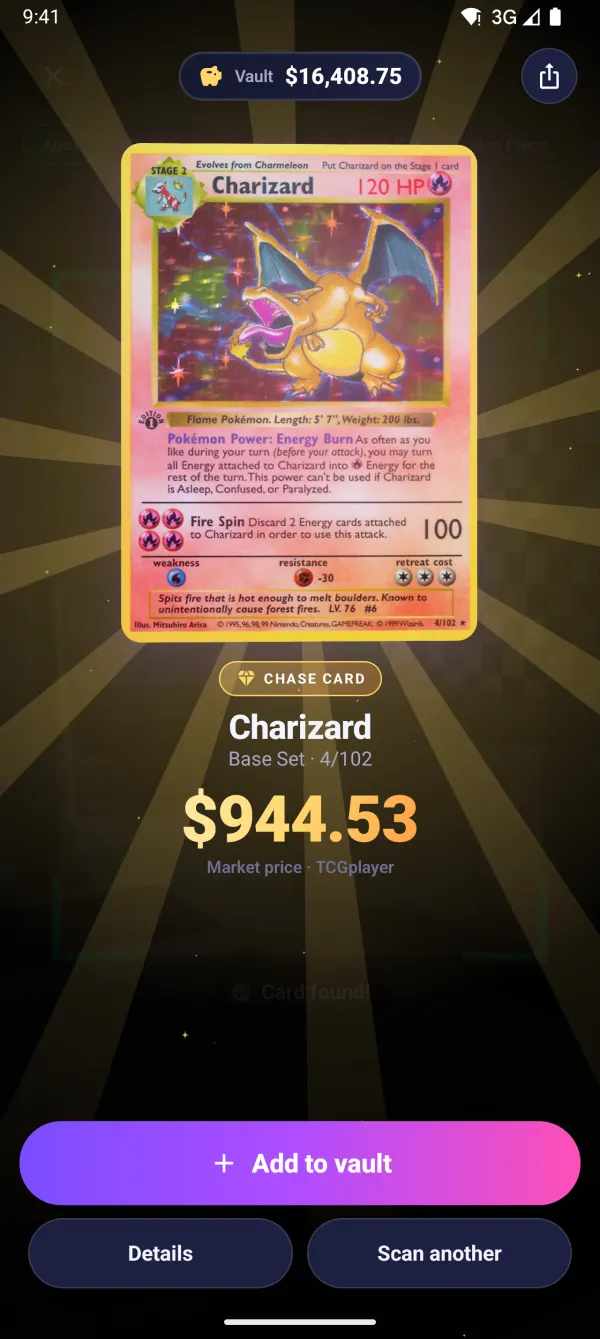
Condition is the last piece of the price puzzle, and our condition guide shows what to check. Japanese cards follow the same logic with a few differences, covered in Japanese vs English Pokémon cards.
Frequently asked questions
What does the number at the bottom of a Pokémon card mean?
It is the card's position and the printed size of the main set: 084/103 is card 84 of that list. If the first number is higher than the second, as in 138/103, the card is a secret rare numbered after the main set.
What is the letter in the bottom-left corner of a Pokémon card?
It is the regulation mark, printed since 2020, which decides whether the card can be used in the Standard format. Since the March 2026 rotation, Standard decks can only use cards marked H, I or J.
How do I find out which set my Pokémon card is from?
Recent English cards print a short set code next to the number, such as DLR for Delta Reign. Older cards only have a set symbol, and the first Base Set cards have none; our set symbol finder helps you match a symbol to its set.
How can I tell if my Pokémon card is 1st Edition?
Look just under the picture on the left: 1st Edition cards from the early Wizards of the Coast sets have a small black stamp with a 1 and the word Edition. Without the stamp, the card is a later Unlimited print (or, for Base Set, possibly Shadowless).
Sources
Related guides
Collecting basicsPokémon card rarity symbols: what every mark meansPokémon card rarity symbols explained: circle, diamond, star, every star tier up to Mega Hyper Rare, and Japanese codes such as AR, SR and SAR. Card valuesHow much is my Pokémon card worth?How much is my Pokémon card worth? Identify the exact print, check its condition and compare recent sold prices, raw or graded, in a few minutes.Scanning cardsHow to scan Pokémon cards with your phone and see their valueHow to scan Pokémon cards with your phone and see their value: step by step, tips for holos and sleeves, Japanese cards and batch-scanning a binder.
 Collecting basicsHow to spot fake Pokémon cardsHow to spot fake Pokémon cards: compare with a real copy, then check text, energy symbols, colours, the back, print under a loupe, holo and light test.