
Collecting basics
Pokémon card rarity symbols: what every mark means
Look at the bottom of the card, next to the card number: a black circle means Common, a diamond Uncommon and a star Rare. Modern sets add tiers marked with two or three stars in black, silver or gold, and Japanese cards print letter codes such as AR, SR or SAR instead. This guide decodes every symbol and shows what each tier looks like in a real set.
Where to find the rarity symbol
The rarity symbol is printed in the bottom strip of the card, right beside the card number. On current English cards that strip sits in the bottom-left corner (for example 084/103 followed by a small symbol); on older cards you may find it in the bottom-right. Wherever it is, it tells you how scarce that print is in booster packs, which is the first clue to what the card is worth.
Rarity belongs to the print, not to the Pokémon. The same Pokémon often appears in one set at several rarities, each with its own number, artwork and price, so you need the exact number and symbol before you look up a value. Our guide on how to read a Pokémon card explains the rest of that bottom strip.
The basic three: circle, diamond and star
Since the first English sets, the core of every expansion has used the same three black symbols:
- Black circle: Common. The largest group in every set.
- Black diamond: Uncommon. One step scarcer than the commons.
- Black star: Rare. In older sets the same star covered holofoil and non-holo rares alike; the shine was the only difference.
Promo cards use a black star with the word PROMO. They come from events, boxes and special products rather than from regular booster packs.
Reverse holo is a finish, not a rarity. Commons, uncommons and rares can all come in a reverse holo version, with foil across the card except the artwork. The rarity symbol stays the same, but the price often does not: a reverse holo common can sell for several times the regular print, so pick the right version when you check a price.
 EeveeDelta Reign · 078/103$0.61
 Adventure LanternDelta Reign · 090/103$0.26
 NidoqueenDelta Reign · 057/103$0.39
The modern star tiers
Scarlet & Violet (2023) introduced a clear ladder of stars above Rare, and the Mega Evolution series, which began in September 2025, kept it with a few additions. Count the stars first, then look at their colour:
| Rarity | Symbol | What the card looks like |
|---|---|---|
| Double Rare | Two black stars | A Pokémon ex with regular artwork, numbered inside the main set |
| Ultra Rare | Two silver stars | Full-art Pokémon ex and Supporters; recent sets also print special Item and Energy cards at this tier |
| Illustration Rare | One gold star | A regular (non-ex) Pokémon in artwork that fills the whole card |
| Special Illustration Rare | Two gold stars | Full-card scene artwork for a Pokémon ex or a Supporter |
| Hyper Rare | Three gold stars | The gold cards of Scarlet & Violet sets |
| Mega Hyper Rare | Its own Mega symbol | An all-gold, embossed Mega Evolution Pokémon ex, numbered last in each Mega Evolution set |
| Mega Attack Rare | Two pastel stars, one pink and one green | A special full-art Mega Evolution Pokémon ex, first seen in English in Ascended Heroes |
| Shiny Rare / Shiny Ultra Rare | One / two sparkling stars | Shiny-coloured Pokémon from Paldean Fates; the Shiny Ultra Rares are Pokémon ex |
| ACE SPEC Rare | Check the card text | Trainer or Special Energy cards with the rule "You can't have more than 1 ACE SPEC card in your deck" |
Two quick rules help. Black stars belong to the main part of the set and are numbered within the printed total; silver and gold stars mark the chase cards numbered past it. And on almost any modern set page, the top of the price list is dominated by gold-star cards.
Secret rares: numbers above the set total
The card number has two parts: the card's position and the printed size of the main set. When the first number is higher than the second, as in 138/103, you are holding a secret rare, a card left out of the printed count. Older sets used the label Secret Rare for gold, rainbow and other special cards numbered this way, like Charizard 146/144 from Skyridge or Shining Charizard 107/105 from Neo Destiny. In current sets, every Illustration Rare, Ultra Rare, Special Illustration Rare and Mega Hyper Rare is numbered past the total.
Promo cards are the exception to the pattern: they carry a promo code or a plain number instead of a position out of a set total.
A real set, tier by tier: Delta Reign
Delta Reign (set code DLR, released November 6, 2026) shows the whole ladder in one expansion. This is how many cards it has at each rarity:
| Rarity | Cards |
|---|---|
| Common | 50 |
| Uncommon | 33 |
| Ultra Rare | 17 |
| Illustration Rare | 14 |
| Rare | 10 |
| Double Rare | 10 |
| Special Illustration Rare | 6 |
| Mega Hyper Rare | 1 |
Mega Rayquaza ex appears three times: as the Double Rare inside the main set (084/103), as a Special Illustration Rare (138/103) and as the Mega Hyper Rare that closes the list (141/103). The attack and HP are identical; the price is not. The Double Rare sells for $7.39, the Special Illustration Rare for $312.70. Eevee shows the same jump for a regular Pokémon: the Common at 078/103 against the Illustration Rare at 114/103, which sells for $28.06.
 Mega Rayquaza exDelta Reign · 084/103$7.39
 Mega Rayquaza exDelta Reign · 138/103$312.70
 Mega Rayquaza exDelta Reign · 141/103$273.82EeveeDelta Reign · 078/103$0.61
 EeveeDelta Reign · 114/103$28.06
Every card of the set, with its rarity and price, is on the Delta Reign page, and you can open any other expansion from the list of sets.
Mega Evolution and 30th Celebration specials
- Mega Hyper Rare. A new rarity in the Mega Evolution set (September 2025), where Mega Lucario ex 188/132 and Mega Gardevoir ex 187/132 were the first. It takes the place of the gold Hyper Rare, and every Mega Evolution expansion since has closed its list with Mega Hyper Rare cards.
- Mega Attack Rare. Marked with two pastel stars, one pink and one green. In English it arrived with Ascended Heroes in January 2026, on Mega Evolution Pokémon ex such as Mega Gengar ex 269/217.
- Pikachu Rare. 30th Celebration (September 2026) puts one foil Pikachu card in every booster pack, each drawn by a different artist. Price guides file them as Pikachu Rare.
- Futuristic Rare. A new rarity introduced in 30th Celebration, with artwork by Japanese artist YOSHIROTTEN, for example Mew ex 158/128 and Mewtwo ex 157/128.
- Classic Collection. Foil reprints of famous cards from the game's history, such as Base Set Charizard, found in 30th Celebration. According to the announcement, the classic cards from booster packs are not legal in the Standard format.
- RGB Rare. TCGplayer files a few 30th Celebration Mew cards, marked R/RGB, G/RGB and B/RGB, under this name, and they sit among the highest-priced cards in our data. We have not found an official description of them, so we only show their listings and prices.
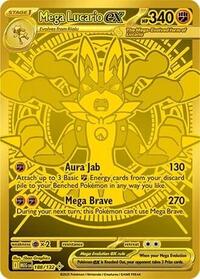 Mega Lucario exMega Evolution · 188/132$200.83
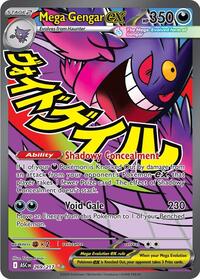 Mega Gengar exAscended Heroes · 269/217$32.09
 Mew ex30th Celebration · 158/128$33.42
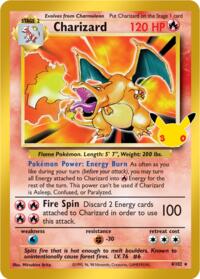 Charizard30th Classic Collection · 4/102$121.26
Japanese rarity codes
Japanese cards print the rarity as letters next to the card number, which makes them easy to read once you know the codes. Most have a direct English counterpart:
| Japanese code | Name | Closest English tier |
|---|---|---|
| C | Common | Common (circle) |
| U | Uncommon | Uncommon (diamond) |
| R | Rare | Rare (one black star) |
| RR | Double Rare | Double Rare |
| AR | Art Rare | Illustration Rare |
| SR | Super Rare | Ultra Rare |
| SAR | Special Art Rare | Special Illustration Rare |
| UR | Ultra Rare (gold) | Hyper Rare |
| MUR | Mega Ultra Rare | Mega Hyper Rare |
| MA | Mega Attack Rare | Mega Attack Rare |
Watch out for UR: on a Japanese card it is the gold tier, while an English Ultra Rare is the silver-star full art. MUR arrived in Japan in August 2025 with the first MEGA sets; it goes to the Mega Evolution Pokémon ex featured on the pack and has a gold sheen. MA, the Mega Attack Rare, first appeared in the high-class pack MEGA Dream ex.
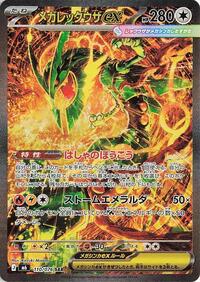
Storm Emeralda, the Japanese counterpart of Delta Reign, makes the match easy to see: Mega Rayquaza ex 113/076 is its MUR and 110/076 its SAR, the equivalents of the English 141/103 and 138/103.
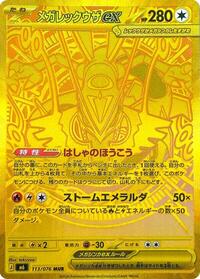
For the wider differences in printing, numbering and price, read Japanese vs English Pokémon cards or open the Storm Emeralda page.
Rarity is not the same as value
Rarity sets the starting point; demand sets the price. The Pokémon matters (Charizard, Pikachu, Umbreon and Mew tend to sell for more than other Pokémon at the same rarity), and so do the artwork, the version, the condition and the age of the card. A Common can be valuable when it is old and sought after, like Pikachu from Legendary Collection at $1,574.99, while some Ultra Rares from a brand-new set sell for very little.
To see where a card stands, check its set page or the most valuable Pokémon cards. To identify a card you are holding, search it by name and number with the card search, or point your phone at it with Foilmon: the app recognises the card from its artwork and shows TCGplayer and Cardmarket prices for the version you pick, from Holo to Reverse Holo.
Frequently asked questions
What does a gold star mean on a Pokémon card?
On Scarlet & Violet and Mega Evolution cards, one gold star marks an Illustration Rare, two gold stars a Special Illustration Rare and three gold stars a Hyper Rare. Gold-star cards are numbered past the set total and are usually the most valuable in their set.
What is the top rarity in a Mega Evolution set?
The Mega Hyper Rare: an all-gold Mega Evolution Pokémon ex numbered last in the set, such as Mega Rayquaza ex 141/103 in Delta Reign. On Japanese cards the same tier is printed as MUR.
Why is my card number higher than the set total?
Because it is a secret rare. Cards numbered past the printed total, like 138/103, sit outside the main list; in modern sets they are the Illustration Rares, Ultra Rares, Special Illustration Rares and Mega Hyper Rares.
What do AR, SR and SAR mean on Japanese Pokémon cards?
AR is Art Rare (the English Illustration Rare), SR is Super Rare (the English silver-star Ultra Rare) and SAR is Special Art Rare (the English Special Illustration Rare). UR on a Japanese card is the gold tier.
Is a reverse holo a rarity?
No. Reverse holo is a foil finish that commons, uncommons and rares can have; the rarity symbol does not change. The price often does, so choose the right version when you look a card up.
Sources
- Understanding Pokémon Rarity Symbols and Card Features (CGC)
- All Pokémon card rarity symbols explained (Wargamer)
- Mega Evolution Quick Facts (TCGplayer)
- Mega Evolution gold Mega Hyper Rare cards (Wargamer)
- Pokémon Unveils New Pokémon Trading Card Game: 30th Celebration Expansion (Pokémon press site)
- Pokémon TCG 30th Celebration set revealed, with a new Futuristic rarity (Wargamer)
- Shiny Pokémon and rare cards in Paldean Fates (The Card Vault)
- Neo Upper Energy, Temporal Forces 162: ACE SPEC Rare (Dittobase)
- ACE SPEC cards (Serebii)
- MUR (Mega Ultra Rare) explained (SNKRDUNK, Japanese)
- Mega Dragonite ex MUR and the new MA rarity (Gamepedia, Japanese)
- Identifying Rare Pokémon Cards: rarity scales (SNKRDUNK)
Related guides
 Collecting basicsHow to read a Pokémon card, from the name to the card numberHow to read a Pokémon card: name, HP, type, attacks, weakness, set code, card number, regulation mark and rarity, and how they lead to the right price.
 Japanese cardsJapanese vs English Pokémon cards: what actually differsJapanese vs English Pokémon cards: release timing, set sizes, 5-card packs, rarity names (AR, SAR, MUR), quality, prices and how to identify the set.Card valuesDelta Reign most valuable cardsThe most valuable Delta Reign cards today: top 20 by TCGplayer market price, why each chase card is wanted and the full rarity breakdown of the set.
 Collecting basicsPokémon card condition: how to judge your cards like a sellerPokémon card condition guide: what Near Mint, Lightly Played, Moderately Played, Heavily Played and Damaged mean, what to inspect and how to store cards.