
Collecting basics
Pokémon card condition: how to judge your cards like a seller
Marketplaces grade raw Pokémon cards on a simple scale: Near Mint (NM), Lightly Played (LP), Moderately Played (MP), Heavily Played (HP) and Damaged. Each step down lowers the price, and on valuable cards the gap is wide. To place a card on that scale, check four things under good light: centering, corners, edges and surface.
The condition scale marketplaces use
TCGplayer, the marketplace behind the US prices on this site, lets sellers list cards in five conditions. Mint and Gem Mint are not used there: a flawless raw card is simply Near Mint, and anything above that is the job of a grading company.
| Condition | What it allows | Effect on price |
|---|---|---|
| Near Mint (NM) | Looks nearly unplayed: crisp corners, clean edges, at most slight edge wear or a couple of minor scratches | The highest price for a raw card |
| Lightly Played (LP) | Minor edge wear, scuffs or scratches; nothing severe and no problem with the card's structure | A modest discount |
| Moderately Played (MP) | Edge and surface wear, scratching, even bends with creases, as long as the card stays structurally sound | A clear discount |
| Heavily Played (HP) | Major wear, creasing, whitening and other faults, but the card can still be authenticated and is not structurally damaged | A large discount; mostly bought to fill a binder slot or to play |
| Damaged | Wear beyond the other grades: tears, splitting, major bends, liquid damage; also bad miscuts and alterations such as stamps, signatures or marker | The lowest price |
Cardmarket, the marketplace behind our European prices, uses its own seven-step scale: Mint, Near Mint, Excellent, Good, Light Played, Played and Poor. The names do not line up one-to-one with TCGplayer's. Cardmarket's Light Played is fifth on its scale, below Excellent and Good, so don't treat it as the same grade as TCGplayer's Lightly Played. Cardmarket also spells out a few hard rules: visible clouding rules out Near Mint, a scratch makes a card Good at best, and inked or whitened borders mean Poor.
What to inspect: the four areas graders look at
Centering
Compare the border width left against right and top against bottom, on the front and on the back. A small shift is normal, and plenty of cards leave the factory slightly off-centre. Marketplace conditions barely care unless the card is badly miscut, which TCGplayer treats as Damaged. Grading companies care a lot: PSA asks for roughly 55/45 or better on the front and 75/25 on the back for a Gem Mint 10, and CGC uses the same limits for its Gem Mint 10, with 50/50 reserved for its Pristine 10.
Corners
Look for whitening (the white core of the card showing through the colour), rounding and small dings. Corners are the first thing to wear when a card is shuffled or slid in and out of a binder pocket, and one soft corner is often what separates Near Mint from Lightly Played.
Edges
Run your eye along all four edges on both sides. Small white chips stand out most against the dark blue border on the back. Factory cutting can leave rough edges even on cards that have never been played.
Surface
Tilt the card under a light to catch scratches, scuffs, fingerprints, dents and indentations, plus clouding on foil cards. Holo, reverse holo and full-art cards show marks more easily than plain ones. Print lines, thin lines left by the printing process, are factory flaws, but buyers and graders can still count them against the surface.
Bends and creases
A crease, a fold you can see as a line across the card, is one of the most expensive flaws. In TCGplayer's scale, bends with creases first appear at Moderately Played, and heavy creasing is typical of Heavily Played. Hold the card at eye level and look along it to spot a bend you cannot see face on.
How to inspect a card properly
- Prepare. Clean, dry hands and a flat, clean surface, ideally a microfibre cloth to set the card on.
- Use angled light. A desk lamp to one side works better than ceiling light: tilt the card slowly and scratches, dents and clouding appear.
- Magnify. A jeweller's loupe or your phone camera's zoom shows whitening and print lines you will miss by eye. CGC reserves its Pristine 10 for cards that look flawless under 10x magnification, which tells you how closely graders look.
- Check both sides. Whitening is much easier to see on the dark blue back.
- Take it out of the sleeve. Sleeves and toploaders hide surface marks and can reflect light like a scratch; slide the card out carefully over your soft surface.
- Grade by the worst flaw. One crease outweighs four perfect corners.
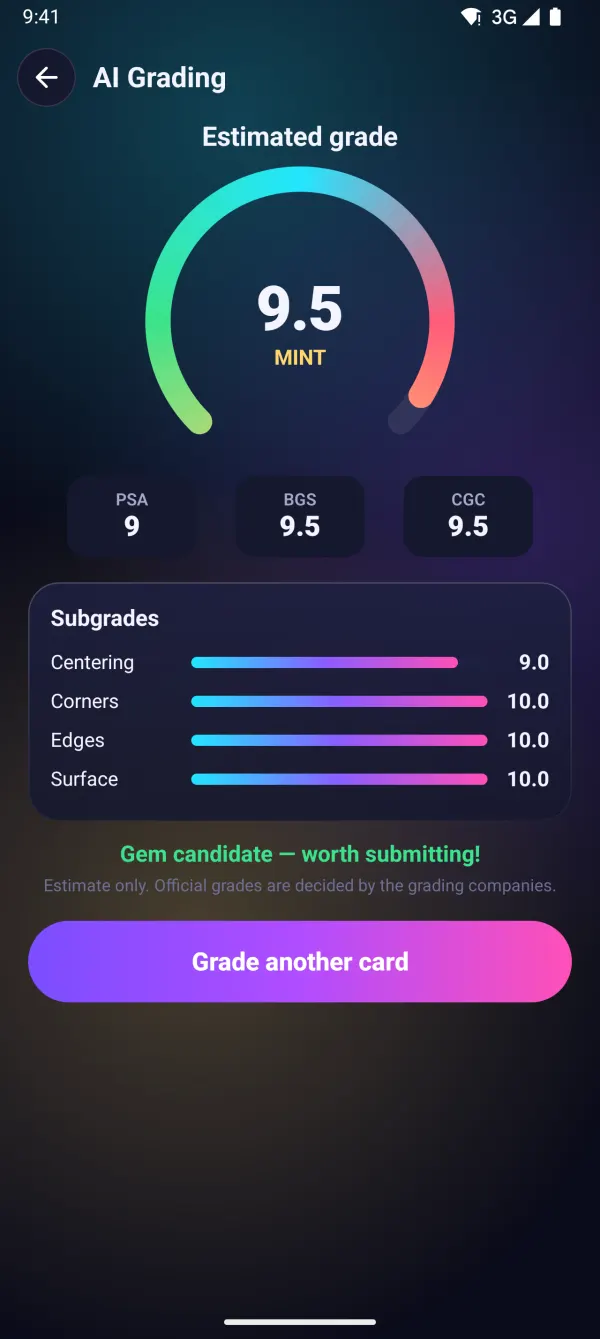
For a second opinion before you sell or grade, Foilmon includes an AI grading check: take a photo of the card and the app reviews centering, corners, edges and surface. It is a quick estimate, not an official grade, but it is consistent and helps you decide which cards deserve a closer look.
How condition changes the price
The discount for each step down depends on the card. On a card that sells for little, the difference between Near Mint and Lightly Played may be small in money terms. On a chase card the same step can cost a lot, and graded copies widen the gap further, because a top-grade slab sells at a premium over a raw copy. These are the kind of cards where one corner ding is a real loss:
 Umbreon exPrismatic Evolutions · 161/131$1,186.84
 Mega Charizard X exPhantasmal Flames · 125/094$570.29
 Mega Rayquaza exDelta Reign · 138/103$312.70
When you price a played card, compare it with sales in the same condition rather than with the headline Near Mint figure. Our guide on how much your Pokémon card is worth walks through it, and the methodology page explains where our prices come from. If a card is close to perfect, read should you grade your Pokémon cards before you sell it raw.
Storage that keeps cards Near Mint
- Penny sleeves for anything worth keeping. A soft, clear sleeve stops scratches and dust from the moment the card leaves the pack.
- Toploaders or semi-rigid holders for valuable cards. Sleeve the card first, then slide it into the rigid holder, so it never rubs against hard plastic. If you plan to grade, note that PSA asks for a penny sleeve inside a semi-rigid holder and no toploaders.
- Side-loading binders with D-rings, or no rings at all. In ring binders the cards nearest the rings can be pressed and dented, which is why collectors avoid round O-ring binders for anything valuable. Choose pages sold as acid-free and PVC-free.
- One card per pocket. Two cards back to back in a pocket rub against each other.
- Cool, dry and dark. Humidity makes cards curl and sunlight fades them. Keep rubber bands away from your cards; they dent edges.
- Boxes with cards standing up. Loose stacks under weight can bend; sleeved cards standing in a storage box are safer.
Once your cards are protected, keep track of them: Foilmon adds up the value of your collection with its daily change, so you can see which cards deserve a toploader first.
Frequently asked questions
What does Near Mint mean for a Pokémon card?
A Near Mint card looks nearly unplayed: crisp corners, clean edges and a nearly unmarked surface, with at most slight edge wear or a couple of minor scratches. On TCGplayer it is the best condition for a raw card.
Is a card straight from the pack always Near Mint?
No. Factory issues such as off-centre cutting, rough edges and print lines can be there from day one, and a bad miscut counts as Damaged on TCGplayer. Inspect pack-fresh cards before you list or grade them.
What is the difference between Lightly Played and Moderately Played?
Lightly Played allows minor edge wear, scuffs or scratches, none of them severe. Moderately Played allows clearer edge and surface wear and even bends with creases, as long as the card's structure is intact.
Should I keep valuable cards in a binder or a toploader?
Put valuable cards in a penny sleeve inside a toploader or semi-rigid holder. Side-loading binder pages are fine for the rest; avoid round O-ring binders, which can dent the cards nearest the rings.
Can an app grade my Pokémon card?
Foilmon's AI grading check estimates centering, corners, edges and surface from a photo, which helps you decide what to sell or submit. It is not an official grade: only a grading company issues one.
Sources
Related guides
 Card valuesShould you grade your Pokémon cards? How to decide, card by cardShould you grade Pokémon cards? How PSA, CGC, BGS and TAG compare, the math of raw vs graded value after fees and risk, and which cards are worth it.
 Card valuesHow much is my Pokémon card worth?How much is my Pokémon card worth? Identify the exact print, check its condition and compare recent sold prices, raw or graded, in a few minutes.Card valuesPokémon card prices explained: where the numbers come fromPokémon card prices explained: TCGplayer market price, Cardmarket trend, eBay sold listings and graded prices, and why the same card differs by region.
 Collecting basicsHow to spot fake Pokémon cardsHow to spot fake Pokémon cards: compare with a real copy, then check text, energy symbols, colours, the back, print under a loupe, holo and light test.