
Collecting basics
How to spot fake Pokémon cards
Most fake Pokémon cards give themselves away within a minute if you compare them with a genuine copy: a missing accent on "Pokémon", odd fonts, flat colours, a washed-out back, fuzzy print under a loupe or a holo that looks printed on. No single test proves a card is real, so combine several, and keep the destructive ones for cards you don't care about.
Start with a real card to compare
Every check below is easier side by side. Use a genuine card from the same set, or at least the same era, if you have one. If you don't, use a clear picture of the real card: our set pages show the real picture of every card with its number and rarity, and Foilmon shows the matching print as soon as it recognises the artwork.
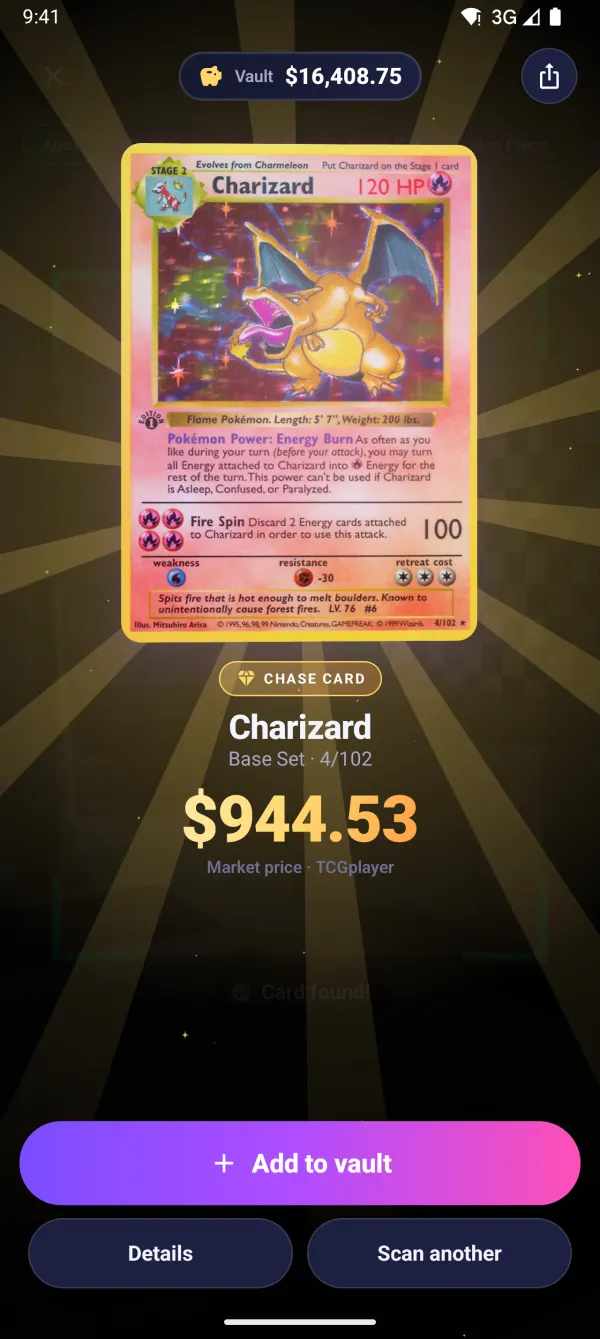
Be clear about what a scanner can and can't do. It tells you which card the artwork matches and what a genuine copy sells for, which is exactly the reference you need. It cannot prove that the card in front of the camera is genuine, because a good fake copies the artwork. Use the result as your comparison, then run the checks.
Counterfeiters copy the cards people pay for: vintage holos and 1st Edition cards, modern chase cards and gold cards. The more a card is worth, the more carefully you should check it.
1. Text, fonts and the é in Pokémon
Genuine cards are proofread before printing; many fakes are not. Look for:
- A missing accent. "Pokemon" instead of "Pokémon" is one of the most reliable tells, because a real printing error there is very unlikely.
- Spelling and grammar mistakes in the name, attacks or card text.
- A font that is slightly off: wrong size, wrong spacing or a different typeface, especially in the small text at the bottom.
- Details that make no sense: HP or damage far too high for the card, the wrong evolution stage, flavour text copied from another card.
- Products that never existed, such as a "2nd Edition" card; vintage sets only have 1st Edition and Unlimited prints.
- A missing copyright line at the bottom of the card.
Our guide on how to read a Pokémon card shows where each element should be.
2. Energy symbols, colours and borders
Energy symbols on fakes are often the wrong size, off-centre, oddly coloured or misaligned with the attack text. Check every one: in the attacks, and in the weakness, resistance and retreat boxes.
Colours are the next tell. Genuine cards are crisp and saturated; fakes tend to look washed out, too dark or slightly blurry. Borders should be even. Real cards can be a little off-centre, but fakes often have borders much thicker than any genuine miscut. Look at the set symbol and card number in the corner too: fakes often blur them or get them wrong.
3. Print quality under a loupe
Use a jeweller's loupe or your phone's macro mode. Cards are printed with tiny dots of four inks that form a rosette pattern in the artwork. On a genuine card, text and thin black lines look solid and sharp, and white areas are clean. Counterfeiters don't have the original print files, so their artwork looks softer, the text is fuzzy around the edges and dots can show up where there should be none.
Grading company CGC caught a fake Japanese card exactly this way: the dot pattern was similar, but the artwork was blurrier, the text and set symbol were fuzzy, and dots appeared in the white areas. Rosettes vary between print runs, so compare with a card from the same set, not just any card.
4. The back
Flip the card. On a genuine back, the blue swirl around the Poké Ball is dappled with darker blue tones. Many fakes show a flat, lighter or washed-out blue instead, or a less detailed Poké Ball. Compare it with a back you know is real, under the same light.
5. Holo, texture and finish
Holofoil is hard to copy. Fake holos often look flat, grainy or printed on, sometimes with a brownish or yellowish tint, and the shine can sit in the wrong part of the card. Check where the foil should be for that exact print: a holo rare and its reverse holo version are foiled in different places.
Many modern ultra-rare and full-art cards have a texture you can feel with a fingertip, and fakes are often smooth. Some genuine misprints lack that texture, so don't judge on it alone. Fakes are also often printed on glossy stock that throws more glare than a real card.
6. Size, thickness and feel
A standard Pokémon card measures 63 × 88 mm (2.5 × 3.5 inches). Lay the suspect card on top of a real one: fakes are sometimes slightly smaller or bigger, thinner, more flexible or noticeably shinier. A precision scale can help, but many modern fakes weigh about the same as a real card, so weight is not a reliable test on its own. Skip the "bend test": it can damage a real card and proves little.
7. The light test
Genuine Pokémon cards have a thin dark layer inside the card stock that blocks light. In a dark room, hold a phone torch behind the card and compare it with a real common: many fakes let much more light through. The test has limits. Better fakes include a dark layer and pass, and holo cards react unpredictably to light. Treat a pass as "not failed yet", not as proof.
8. The rip test, only for bulk
Tearing a card shows whether it has that dark inner layer. It also destroys the card, so it only makes sense on a cheap card you already believe is fake, for example a common from the same suspicious lot. Never rip a card that might be valuable. And remember that a torn fake tells you about that one card, not about every card it came with.
Red flags when you buy
- Prices that are too good to be true. Check the market price first, on our most valuable cards and card pages, or by scanning a card. A chase card at a fraction of its price is a warning, not a bargain.
- Big "lots" full of hits. Real ex, V, GX and full-art cards come out of packs at low rates; a cheap bundle with dozens of them should make you suspicious.
- Stock photos or blurry pictures. Ask for clear, original photos of the front and back of the exact card, and inspect valuable cards in person before paying when you can.
- Sealed product with odd packaging. Stretch marks, bubbles or burn marks near the seals, blurry printing, a wrong copyright year or a product name that never existed point to fake packs and boxes.
- Graded slabs. Slabs can be faked too. Look up the certification number on the grader's website and check that the details match the card and the label.
Fakes turn up mostly where you can't hold the card before paying: general online marketplaces, auction sites and classifieds. Japanese cards get faked too, so a Japanese card is not automatically safe. Specialist shops and marketplaces with buyer protection and seller ratings lower the risk, but don't remove it.
If you think you bought a fake
Don't resell or trade it. Keep the packaging and a copy of the listing, photograph both sides of the card and contact the seller and the platform; marketplaces such as Cardmarket ban counterfeits. For a valuable card you are unsure about, a professional grading company checks authenticity before it grades. Fees and turnaround change, so check the grader's website, and read our guide on whether to grade a card.
For everyday checks, a quick routine works: identify the card, pull up the real picture, then go through text, symbols, colours, back, holo and print under a loupe. You can identify the card with our card search or with the app's camera.
Frequently asked questions
What is the quickest way to tell if a Pokémon card is fake?
Compare it with a genuine copy or a clear picture of the real card. Check the accent in "Pokémon", the fonts, the energy symbols and the blue on the back; most fakes fail at least one of these.
Does the light test prove a Pokémon card is real?
No. Many fakes let more light through than a real card, but better fakes have a dark inner layer and pass. Use it together with the other checks.
Is the rip test safe?
No, it destroys the card. Only use it on a cheap card you already think is fake, never on a card that might be valuable.
Can a card scanner app tell if a card is fake?
No. A scanner identifies which card the artwork matches and shows the real card and its price, which makes comparison easy, but a good fake copies the artwork. Authenticity needs the physical checks.
Are Japanese Pokémon cards faked too?
Yes. Grading company CGC has published an alert about a fake Japanese card, so check Japanese cards with the same care as English ones.
Sources
- How to identify fake Pokémon cards (Wargamer)
- Spotting a Counterfeit (Cardmarket Help)
- Counterfeit Card Alert: Japanese Omanyte (CGC)
- Counterfeit Cards – A "survival guide" – part 3 (Magic Judges Europe East)
- How to tell if pokemon cards are fake [2024 guide] (Remambo)
- How to Spot Fake Pokémon Cards (ShopGoodwill blog)
- Discovering Pokémon Japan: A Guide for Japanese Pokémon Releases (TCGplayer)
Related guides
 Collecting basicsPokémon card condition: how to judge your cards like a sellerPokémon card condition guide: what Near Mint, Lightly Played, Moderately Played, Heavily Played and Damaged mean, what to inspect and how to store cards.
 Card valuesShould you grade your Pokémon cards? How to decide, card by cardShould you grade Pokémon cards? How PSA, CGC, BGS and TAG compare, the math of raw vs graded value after fees and risk, and which cards are worth it.
 Collecting basicsHow to read a Pokémon card, from the name to the card numberHow to read a Pokémon card: name, HP, type, attacks, weakness, set code, card number, regulation mark and rarity, and how they lead to the right price.Scanning cardsHow to scan Pokémon cards with your phone and see their valueHow to scan Pokémon cards with your phone and see their value: step by step, tips for holos and sleeves, Japanese cards and batch-scanning a binder.