
Card values
Pokémon card prices explained: where the numbers come from
Every Pokémon card price is a summary of sales on one marketplace, in one currency, on one day. In the USA the usual reference is the TCGplayer market price, in Europe the Cardmarket price trend, and for rare or graded cards eBay sold listings. Here is how each one works and how to read them without being fooled.
TCGplayer market price (USA, US dollars)
TCGplayer is the main marketplace for single trading cards in the United States, and its market price is the figure most price guides quote. TCGplayer calculates it from recent completed sales on its site, so it reflects what buyers actually paid rather than what sellers hope to get.
Three things to keep in mind:
- Each printing has its own price. Normal, Holofoil, Reverse Holofoil, 1st Edition and Unlimited are separate entries for the same card, and they can be very far apart.
- Thinly traded cards jump. When a card sells only a few times a month, one unusually cheap or expensive sale can move its market price a lot. Vintage cards and graded-quality copies are the usual suspects.
- No sale, no price. On release day many cards have not sold yet. Our pages say "no sales yet" instead of guessing a number.
Listing prices: low, mid and high
Price feeds also carry listing prices: the lowest, middle and highest prices at which copies are on offer right now. These are asking prices, and they mislead in both directions:
- The low price is often a damaged copy, a listing in the wrong language or category, or a seller who makes it back on shipping.
- The mid and high prices include listings that nobody will ever buy. A common listed at a silly price still counts.
That is why we show only the market price, built from sales, and never listing prices.
Cardmarket (Europe, euros)
Cardmarket is the main card marketplace in Europe and the reference for collectors in Spain, Italy, Germany, France and most of the continent. A Cardmarket product page shows several numbers:
- From: the cheapest copy on offer at the moment, in any condition and language. Treat it like TCGplayer's low price.
- Price trend: a figure Cardmarket calculates from recent sales of the card. It is the closest thing Europe has to a market price.
- 30-day, 7-day and 1-day averages: the average sale price over each period. The 30-day average is the steadiest; the 1-day average reacts fastest but can be thrown off by a single sale.
The same Cardmarket page lists copies in several languages and conditions, so filter by language and condition before comparing.
eBay sold listings
eBay is where many rare and graded cards change hands, often at auction. Search for the card and tick "Sold items" to see what copies actually went for, not what is on offer. Look at the photos of each sale: condition, centering and the grade on the slab explain most of the spread. When a listing ends with an accepted best offer, the price you see may not be the amount that was finally paid.
Graded prices
A card graded by PSA, BGS or CGC is in practice a different product from the raw card. Its price depends on the company and on the exact grade: a 10 can sell for many times a 9, and a 9 for well above a raw copy. Graded sales are less frequent, so compare several recent sales of the same grade from the same company, never an average across grades. For whether grading pays off, read should you grade your Pokémon cards? or try the grading calculator.
Why the same card costs differently in the USA and Europe
On many of our card pages you will see a TCGplayer price in dollars and a Cardmarket price in euros that do not match once you convert the currency. That is normal:
- They are separate markets. Few people ship single cards across the Atlantic because of postage, customs and delivery times, so each market finds its own level.
- Supply differs. How much product reaches each region, and when, is not the same.
- Demand differs. Players and collectors in each region chase different cards, and local favourites can carry a premium.
- Fees and taxes differ, and they are not always included in the price you see.
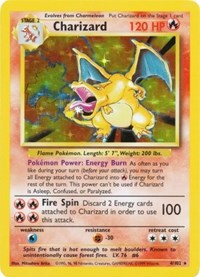
Compare the two prices on Umbreon VMAX (Alternate Art) or Base Set Charizard to see it in practice. Buy and sell in the market where you live, and use the other one only as a reference.
Release week: why new cards swing
New sets are the most volatile. Around release, prices come from preorders and the first handful of sales while most boxes are still sealed. As more product is opened, supply grows and many chase cards settle lower; a few hold or climb if demand stays strong. If you pull a big hit in the first days, the price you see then is the least reliable it will ever be.
Delta Reign, released on November 6, 2026, is a live example: watch how its two Mega Rayquaza ex chase cards, the Special Illustration Rare (now at $312.70) and the gold Mega Hyper Rare (now at $273.82), move over the next weeks, and read the most valuable Delta Reign cards.
How our site shows prices
- TCGplayer market price in US dollars, read every day from TCGCSV, a public site that republishes TCGplayer's catalogue and price data daily.
- Cardmarket price trend in euros, from TCGdex, an open-source Pokémon card database, when it is available for that card.
- A daily snapshot. Every page is rebuilt from the latest data; the prices you are reading are from November 8, 2026.
- Set values. We add up one copy of every card in a set (Delta Reign: $978.54) and, for the master set, every variant including reverse holos (Delta Reign: $997.03). You can do the same for any set with the set value calculator.
No price on this site is typed by hand, and listing prices are never shown. The full method, including which cards get their own page, is on our methodology page. To see the most expensive cards right now, open the most valuable cards.
The same prices in your pocket
The Foilmon app uses the same daily TCGplayer and Cardmarket prices. Scan a card and you get its price history, graded value estimates for PSA, BGS and CGC, and prices in USD, EUR, GBP, JPY and more; market movers and price alerts tell you when a card you own goes up or down.
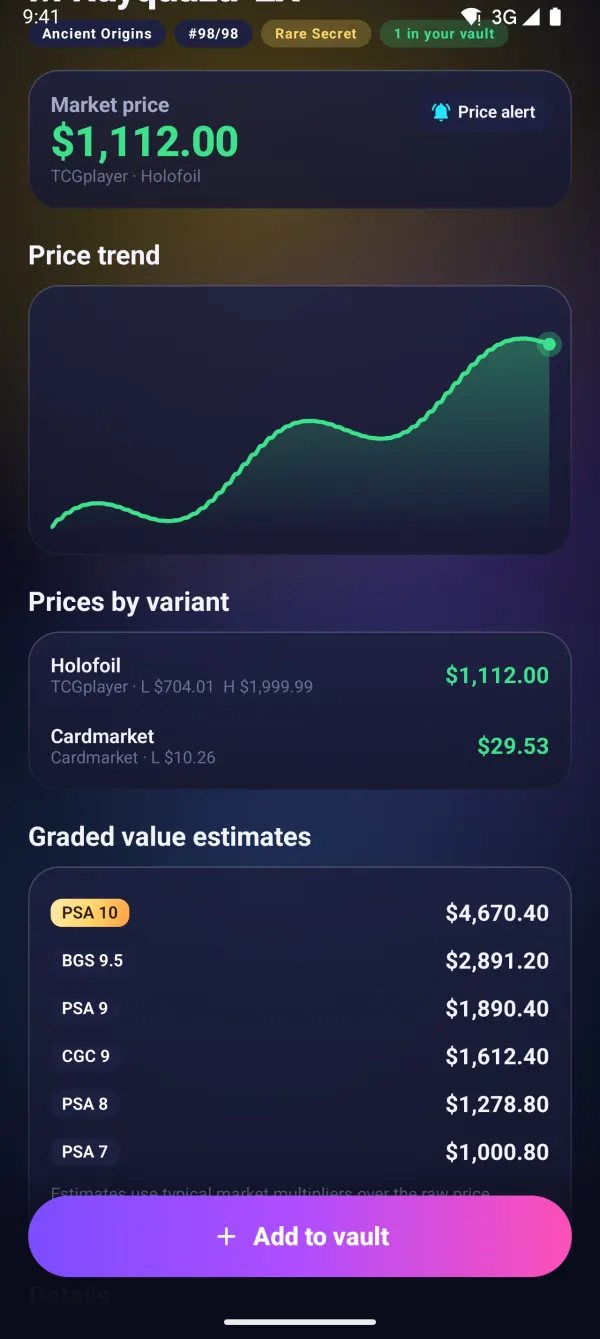
Still not sure what your own card is worth? Follow the steps in how much is my Pokémon card worth?
Frequently asked questions
What does market price mean on TCGplayer?
It is TCGplayer's figure for what a card has been selling for, calculated from recent completed sales on its marketplace. It is in US dollars and is given separately for each printing, such as Holofoil or Reverse Holofoil.
What is the Cardmarket price trend?
It is a price in euros that Cardmarket calculates from recent sales of a product. It is the closest European equivalent of TCGplayer's market price; the 30-day average is a steadier second check.
Why does a card cost more in the USA than in Europe, or the other way round?
TCGplayer and Cardmarket are separate markets with different supply, demand, fees and taxes, and shipping single cards between the USA and Europe is expensive, so prices do not line up after converting currencies.
Which price should I use to sell my card?
Use recent sales of the same printing in the same condition on the marketplace where you will sell: TCGplayer or eBay sold listings in the USA, Cardmarket in Europe. Listing prices are only what sellers ask.
How often are the prices on this site updated?
Every day. The pages are rebuilt from a daily snapshot of TCGplayer and Cardmarket prices, and the date of that snapshot is shown with the prices.
Sources
Related guides
 Card valuesHow much is my Pokémon card worth?How much is my Pokémon card worth? Identify the exact print, check its condition and compare recent sold prices, raw or graded, in a few minutes.Card valuesShould you grade your Pokémon cards? How to decide, card by cardShould you grade Pokémon cards? How PSA, CGC, BGS and TAG compare, the math of raw vs graded value after fees and risk, and which cards are worth it.
 Card valuesDelta Reign most valuable cardsThe most valuable Delta Reign cards today: top 20 by TCGplayer market price, why each chase card is wanted and the full rarity breakdown of the set.
 Card valuesThe most valuable Pokémon cards right nowThe most valuable Pokémon cards right now in English, ranked by TCGplayer market price and updated daily: vintage holos, Gold Stars, alt arts and promos.