
One Piece, Lorcana, Magic & Yu-Gi-Oh!
Yu-Gi-Oh! card rarities explained
A Yu-Gi-Oh! card's rarity is shown by its foil, not by a symbol: look at the card name, then the artwork, then the borders. Together with the set code under the artwork and the edition, the rarity tells you exactly which printing you have and what it is worth. Here is every rarity you are likely to meet and how to read the rest of the card.
How to read a Yu-Gi-Oh! card
Yu-Gi-Oh! cards have no rarity symbol, so start with the printed details that tell you exactly which card you hold:
- Set code (also called the card number or set ID), printed just below the artwork on the right; on Pendulum Monsters it moves to the bottom left, next to ATK and DEF. It has three parts: a short code for the set, a region or language code and the card's number in the set. In LOB-EN001, LOB stands for The Legend of Blue Eyes White Dragon, EN for Worldwide English and 001 for the card. Spanish cards use SP and Italian cards IT. Some early European prints used a single letter instead, and the very first North American English prints had no letters at all, like Red-Eyes B. Dragon with the code LOB-070.
- Edition: most sets are printed as 1st Edition on their first run and as Unlimited later. The text 1st Edition or Limited Edition sits under the left side of the artwork on older cards and at the bottom, to the right of the passcode, on newer ones. Unlimited copies have no edition text.
- Security foil: the small hologram in the bottom right corner, showing the Millennium Eye and the words YU-GI-OH!. It is gold on 1st Edition and Limited Edition cards and silver on Unlimited cards, which makes it the quickest way to check the edition.
- Passcode: the eight-digit number in the bottom left corner. It is the same on every print of a card, in every language and rarity, and it plays no part in the card game: it was used in the video games to add the card to your collection. It identifies the card, not the printing.
- Card name: its foil colour is the first rarity clue, as the table below shows.
Because there is no rarity symbol, one set code can exist in two or more rarities, and marketplaces such as TCGplayer and Cardmarket list the rarity next to the code. Always check both.
Yu-Gi-Oh! rarities at a glance
These are the rarities of booster packs and the special ones you are most likely to find in a collection. Look at the name, then the artwork, then the borders.
| Rarity | Card name | Artwork and the rest of the card |
|---|---|---|
| Common | No foil | No foil |
| Rare | Silver foil | No foil |
| Super Rare | No foil | Holographic artwork |
| Ultra Rare | Gold foil (sometimes another colour) | Holographic artwork |
| Secret Rare | Rainbow foil | Sparkling holographic artwork |
| Ultimate Rare | Gold foil | Embossed foil on the artwork, the Attribute and the Level stars |
| Ghost Rare | Foil (its colour has changed over the years) | Artwork printed as a pale, three-dimensional hologram |
| Starlight Rare | Rainbow foil | Rainbow foil over the artwork and all the borders |
| Collector's Rare | Secret Rare-style foil | Embossed card with rainbow foil on the artwork and border, in a grain that looks like a fingerprint |
| Prismatic Secret Rare | Rainbow foil | Grid-like horizontal and vertical foil, on the artwork only |
| Quarter Century Secret Rare | Gold-toned foil | Secret Rare foil across the card and a 25th anniversary watermark in the text box |
| Platinum Secret Rare | Platinum foil | Platinum-coloured Secret Rare foil over the artwork and borders |
Core booster sets today
Rare, Ultimate Rare and Ghost Rare no longer appear in core booster sets. A recent set such as Beyond the Brave mixes Commons, Super Rares, Ultra Rares, Secret Rares and Starlight Rares; the table below counts the cards of each rarity in that set.
| Rarity | Cards |
|---|---|
| Common | 50 |
| Super Rare | 31 |
| Starlight Rare | 25 |
| Ultra Rare | 19 |
| Secret Rare | 11 |
Ghost and Ultimate Rares: the chase cards of the 2000s
Ghost Rare came to the TCG with Tactical Evolution, and for several years the cover card of almost every core set was a Ghost Rare. It left regular booster sets after Breakers of Shadow and has since come back in special products such as Ghosts From the Past and the Legendary Duelists series. Ultimate Rares were an alternate rarity in core boosters until Breakers of Shadow and have appeared only in tournament packs since. Their raised foil is easy to feel with a fingertip, though it often looks dull in photos.
Here the same card in two rarities makes the point: Black Rose Dragon from Crossroads of Chaos carries the code CSOC-EN039 both as a Ghost Rare ($1,499.09) and as an Ultimate Rare ($1,012.50), and Stardust Dragon from The Duelist Genesis does the same with TDGS-EN040.
 Black Rose Dragon (Ghost Rare)Crossroads of Chaos · CSOC-EN039$1,499.09
 Black Rose Dragon (UTR)Crossroads of Chaos · CSOC-EN039$1,012.50
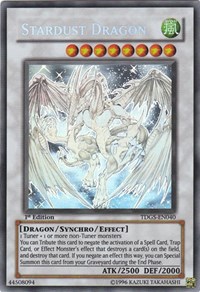 Stardust Dragon (Ghost)The Duelist Genesis · TDGS-EN040$1,212.50
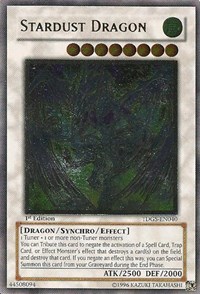 Stardust Dragon (UTR)The Duelist Genesis · TDGS-EN040$722.21
Starlight Rare
Starlight Rare arrived in Rising Rampage (2019). The foil runs over almost the whole card, borders included, in a horizontal, grid-like pattern, leaving only the text box and parts of the artwork without it. It became the top chase rarity of core sets and also appears in the Battles of Legend series from Battles of Legend: Armageddon (2020) on.
Anniversary and collector rarities
For Yu-Gi-Oh!'s 25th anniversary, Konami added the Quarter Century Secret Rare: in the TCG it first appeared in Legendary Collection: 25th Anniversary Edition (April 2023) and was used in most products from 2023 to 2025. Platinum Secret Rare is a TCG-only rarity that debuted in the 2014 Mega-Tins and came back in the 25th Anniversary Rarity Collection, Quarter Century Bonanza, Quarter Century Stampede and Rarity Collection 5. Collector's Rare first appeared in Toon Chaos (2020), and the 25th Anniversary Rarity Collection added two more versions, Prismatic Collector's Rare and Prismatic Ultimate Rare. A collector set like Quarter Century Bonanza mixes many of them:
| Rarity | Cards |
|---|---|
| Platinum Secret Rare | 281 |
| Quarter Century Secret Rare | 281 |
| Super Rare | 81 |
| Prismatic Collector's Rare | 81 |
| Prismatic Ultimate Rare | 81 |
| Secret Rare | 81 |
| Ultra Rare | 81 |
Special and one-off rarities
- Prismatic Secret Rare: early TCG video game promos used it, such as Blue-Eyes White Dragon from Dark Duel Stories (DDS-001). It returned in 2015 and has been a regular in tin mega packs since 2019.
- Gold Rare: gold name, gold artwork frame and borders, from the Gold Series. Premium Gold Rare adds embossed gold to the borders and icons and comes from the Maximum Gold sets.
- Parallel rares such as Starfoil, Shatterfoil and Mosaic: a foil film over the whole card on top of its base rarity, found in products such as Duel Terminal, Battle Packs and Star Packs.
- 10000 Secret Rare: a rarity of its own, used only for Ten Thousand Dragon.
The cards below show some of these rarities side by side: an Ultra Rare from the first set, an early Secret Rare, a Starlight Rare, a Prismatic Secret Rare promo, a Limited Edition Super Rare prize card and the one-off 10000 Secret Rare.
 Red-Eyes B. DragonThe Legend of Blue Eyes White Dragon · LOB-070$850.00Dark Magician GirlMagician's Force · MFC-000$699.99
 Dragon Master Magia (Starlight Rare)Battles of Legend: Glorious Gallery · BLGG-EN137$1,163.80
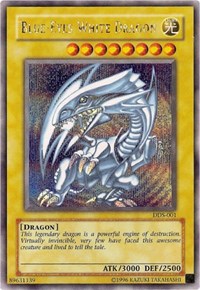 Blue-Eyes White Dragon (Dark Duel Stories)Yu-Gi-Oh! Video Game Promotional Cards · DDS-001$1,450.56
 Number 106: Giant HandYu-Gi-Oh! Championship Series Prize Cards · YCSW-EN006$899.99
 Ten Thousand DragonBattles of Legend: Armageddon · BLAR-EN10K$719.55
How to price a Yu-Gi-Oh! card
- Read the set code under the artwork: it tells you the set and the card.
- Name the rarity from the foil, using the table above.
- Check the edition: 1st Edition, Limited Edition or Unlimited. Unlimited copies usually sell for less than 1st Edition copies of the same rarity.
- Judge the condition: corners, edges, surface scratches and creases. A creased card drops a long way.
- Look up that exact combination: the TCGplayer market price or the Cardmarket price trend, built from recent sales, not the highest listing you can find.
Our Yu-Gi-Oh! hub lists every set we track with its most valuable cards, and each card page shows its TCGplayer market price and price history. To see which rarities and printings top the market right now, read the most valuable Yu-Gi-Oh! cards.
Let the app read the card for you
The Foilmon app recognises Yu-Gi-Oh! cards by reading the card's name and set code with your phone's camera. You choose the exact rarity and edition you own, then see TCGplayer and Cardmarket prices, updated daily, and the app adds the card to the total value of your collection. Our guide to scanning Yu-Gi-Oh! and Magic cards has tips for foils and sleeves.
Frequently asked questions
What are the Yu-Gi-Oh! rarities in order?
From plain to most foil, the classic order is Common, Rare, Super Rare, Ultra Rare and Secret Rare, with Ultimate, Ghost and Starlight Rare above them as special chase rarities. Price does not follow a fixed order: the card matters as much as the rarity.
How do I know if my Yu-Gi-Oh! card is 1st Edition?
Look for the 1st Edition text, under the artwork on older cards or next to the passcode on newer ones, and check the security foil in the bottom right corner: gold means 1st Edition or Limited Edition, silver means Unlimited.
What does LOB-EN001 mean on a Yu-Gi-Oh! card?
It is the set code: LOB is the set (The Legend of Blue Eyes White Dragon), EN is the region or language (Worldwide English) and 001 is the card's number in the set.
What is the difference between Ultra Rare and Ultimate Rare?
Both have a gold name. An Ultra Rare has flat holographic artwork, while an Ultimate Rare has embossed foil you can feel on the artwork, the Attribute and the Level stars.
Is the passcode the same on every copy of a card?
Yes, with a handful of exceptions. The eight-digit passcode is the same on every print of a card in every language and rarity, so it identifies the card but not the printing.
Sources
- New to Yu-Gi-Oh!: rarities, password and security foil (yugioh-card.com)
- How To Understand Yu-Gi-Oh Card Rarity (TCGplayer)
- Understanding Yu-Gi-Oh! Rarities (TCGplayer Seller Blog)
- What Is A Starlight Rare Foil In Yu-Gi-Oh? (TCGplayer)
- Card Number (Yugipedia)
- 1st Edition (Yugipedia)
- Limited Edition (Yugipedia)
- Password (Yugipedia)
- Ghost Rare (Yugipedia)
- Ultimate Rare (Yugipedia)
- Starlight Rare (Yugipedia)
- Quarter Century Secret Rare (Yugipedia)
- Platinum Secret Rare (Yugipedia)
- Prismatic Secret Rare (Yugipedia)
- Collector's Rare (Yugipedia)
Related guides
One Piece, Lorcana, Magic & Yu-Gi-Oh!The most valuable Yu-Gi-Oh! cards right nowThe most valuable Yu-Gi-Oh! cards right now by TCGplayer market price: Ghost Rares, Starlight Rares, Ultimate Rares, 1st Edition classics and prize cards. One Piece, Lorcana, Magic & Yu-Gi-Oh!How to scan Yu-Gi-Oh! and Magic cards with your phoneHow to scan Yu-Gi-Oh! and Magic cards with your phone: read the name and set code, choose the exact printing and see TCGplayer and Cardmarket prices.
 One Piece, Lorcana, Magic & Yu-Gi-Oh!How much are my Magic: The Gathering cards worth?How much are your Magic: The Gathering cards worth? Find the exact printing, foil and version, check condition and compare real market prices.
 Collecting basicsPokémon card rarity symbols: what every mark meansPokémon card rarity symbols explained: circle, diamond, star, every star tier up to Mega Hyper Rare, and Japanese codes such as AR, SR and SAR.