
One Piece, Lorcana, Magic & Yu-Gi-Oh!
How much are my Magic: The Gathering cards worth?
A Magic card is worth what the exact same printing, in the same finish and condition, has recently sold for. Most cards in a box are bulk, but old Reserved List cards, foils and special versions from Collector Boosters can be worth a lot. Here is how to tell which is which.
Step 1: identify the exact printing
Many Magic cards have been printed again and again, with the same name and the same rules text but very different prices. Before you look anything up, work out which printing you are holding. These are the details that matter:
- Name, at the top of the card.
- Expansion symbol, at the right end of the type line, between the artwork and the text box. Its colour shows the rarity: red-orange for mythic rare, gold for rare, silver for uncommon, black or white for common. Before Exodus every symbol was black, and the core sets before Sixth Edition had no symbol at all.
- Information line, at the bottom left of modern cards: the collector number, a single letter for the rarity, a three-character set code and a two-letter language code. On foil cards the set code and the language code are separated by a star instead of a bullet point, a quick way to spot foils in a stack.
- Finish and version: non-foil or foil, and any special frame or art (see the list below).
- Language: the language code tells you which one you have. Copies in different languages can sell at different prices, so compare like with like.
Not every set printed all of this information, and the oldest cards have no collector number at all. For those, the expansion symbol and the frame style are your clues; our Magic: The Gathering hub lists every set we track so you can compare.
Versions and treatments
Modern sets print several versions of their most popular cards, many of them only in Collector Boosters. The rules text is identical; the price is not.
- Borderless: alternate art that runs to the edges of the card.
- Extended art: the same art as the regular card, in a frame that shows more of it.
- Showcase: a special frame designed for one set, such as the hedron-shaped frame of Zendikar Rising.
- Retro frame: a tribute to the card frame Magic used before the modern one, back in boosters since Modern Horizons 2 in 2021.
- Special foils: besides traditional foil there are etched foils, introduced in Commander Legends, which add a grainy sparkle to parts of the card, plus raised foils and other finishes in recent sets.
- Serialized: a stamped number out of a fixed total that tells you how many copies exist. Magic's first booster product with them was The Brothers' War (2022).
Alternate versions also have their own collector numbers, so the number on your card points to the exact version. The finish alone can change everything: for Birds of Paradise from 7th Edition, the price we show, $3,980.75, is for the foil, and the non-foil sells for a small fraction of it. The cards below show the main families of high-value Magic cards: an old foil, a Reserved List card, a non-tournament-legal reproduction, a borderless poster version, a serialized card and a Secret Lair foil.
 Birds of Paradise7th Edition · 231$3,980.75
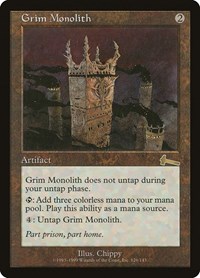 Grim MonolithUrza's Legacy · 126$3,483.66
 Black Lotus30th Anniversary Edition · 228$3,299.99
 The One Ring (Borderless Poster)Universes Beyond: The Lord of the Rings: Tales of Middle-earth · 748$2,180.88
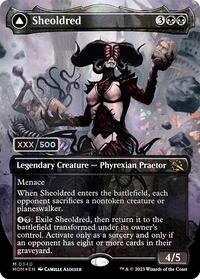 Sheoldred (Serial Numbered)March of the Machine · 340$3,165.46
 Mana Vault (Rainbow Foil)Secret Lair Drop Series · 796$4,500.00
Step 2: check the condition
After the printing, condition moves the price the most. Take the card out of its sleeve and look at it under a bright light, front and back:
- Corners: sharp, or rounded and white?
- Edges: white chipping shows up easily on the dark blue-brown back of Magic cards.
- Surface: scratches, scuffs, dents, print lines, stains. Foils show scratches more than non-foils.
- Creases and bends: a single crease is usually enough to drop a card into the played grades.
TCGplayer sorts cards as Near Mint, Lightly Played, Moderately Played, Heavily Played and Damaged; Cardmarket uses Mint, Near Mint, Excellent, Good, Light Played, Played and Poor. The checks in our card condition guide are written for Pokémon cards, but they work the same way for Magic.
Step 3: look up the market price, not the asking price
Anyone can list a card at any price. What a card is worth is what buyers have actually paid recently for that printing in that condition:
- TCGplayer market price (United States, in US dollars), calculated from recent sales.
- Cardmarket price trend (Europe, in euros), the usual reference for players in Spain, Italy and the rest of Europe.
- eBay sold listings, with the "Sold items" filter on, for expensive or graded cards that only sell now and then.
On this site every Magic card above a minimum value has its own page with its TCGplayer market price and price history, and each set page, such as The Hobbit, Ravnica Remastered or Secret Lair Drop Series, ranks its cards by price. Our methodology page explains where the prices come from. Keep in mind that a shop buying your cards will pay less than the market price, and that marketplace fees and shipping eat into what you keep.
Bulk or valuable: what to pull out of a box
Most commons and uncommons from recent sets are bulk: worth little one by one and usually sold by the hundred or the thousand. Before you sell a box as bulk, set these aside and look them up one at a time:
- Cards from the early years. The Reserved List covers cards from Limited Edition (Alpha) through Urza's Destiny that Wizards of the Coast has promised never to reprint in a functionally identical, tournament-legal form. Not every card from those sets is on it, but old cards deserve a careful look.
- Rares and mythic rares: a gold or red-orange expansion symbol.
- Foils, especially from older sets.
- Special versions: borderless, extended art, showcase, retro frame and anything with a serial number.
- Secret Lair cards and promos, including cards with a stamp or an unusual frame.
Prices also move with play: a card that becomes popular in a format can climb quickly. The 30-day price rises on the Magic hub show which cards are moving right now, and our list of the most valuable Magic cards shows what sits at the top.
Is it worth grading a Magic card?
Grading companies such as PSA, BGS (Beckett) and CGC also grade Magic cards: they give the card a grade from 1 to 10 and seal it in a plastic slab. A top grade can multiply the price of a card that is already valuable, while a low grade adds little. Grading costs money and takes time, and both change, so check fees and waiting times on the grader's own website. In most cases it only pays off for valuable cards in near-perfect condition; the reasoning in should you grade your cards? applies to Magic too.
The fastest way: scan your cards
Typing names and collector numbers into a search box works for a few cards, not for a binder. The Foilmon app recognises Magic: The Gathering cards by reading the card's name and set number with your phone's camera. You choose the exact printing, then see its TCGplayer and Cardmarket prices, updated daily, and its price history. Batch scanning reads many cards in a row, and the app adds up the value of your collection with its daily change. Our step-by-step guide to scanning Magic and Yu-Gi-Oh! cards has tips for foils and sleeves.
Frequently asked questions
How do I know which set my Magic card is from?
Look at the expansion symbol at the right end of the type line and, on modern cards, the three-character set code in the information line at the bottom left. Older cards only have the symbol, so compare it with the set list on our Magic hub.
Are old Magic cards worth money?
Some are worth a lot, above all Reserved List cards from Limited Edition through Urza's Destiny, which will never be reprinted in tournament-legal form. Many old commons and uncommons are still cheap, so look up the exact printing.
What does the star at the bottom of my Magic card mean?
On modern cards, a star between the set code and the language code means the card is a foil (premium) copy. Non-foil copies have a bullet point there instead.
Is a borderless or extended-art version worth more?
Often, because many of these versions come mainly from Collector Boosters, but it depends on the card. Check the price of the exact version you own on its card page.
Can I check Magic card prices with my phone camera?
Yes. The Foilmon app reads the card's name and set number with the camera and shows TCGplayer and Cardmarket prices, updated daily.
Sources
- Magic: The Gathering Comprehensive Rules, rules 206 and 213 (media.wizards.com)
- Official Reprint Policy (magic.wizards.com)
- Collecting Zendikar Rising (magic.wizards.com)
- A First Look at The Brothers' War (magic.wizards.com)
- What is an Etched Foil in Magic: The Gathering? (TCGplayer)
- What is a Retro Frame Card in Magic: The Gathering? (TCGplayer)
Related guides
One Piece, Lorcana, Magic & Yu-Gi-Oh!The most valuable Magic: The Gathering cards right nowThe most valuable Magic: The Gathering cards right now by TCGplayer market price: Reserved List cards, serialized cards, Secret Lair and borderless foils. One Piece, Lorcana, Magic & Yu-Gi-Oh!How to scan Yu-Gi-Oh! and Magic cards with your phoneHow to scan Yu-Gi-Oh! and Magic cards with your phone: read the name and set code, choose the exact printing and see TCGplayer and Cardmarket prices.
 Collecting basicsPokémon card condition: how to judge your cards like a sellerPokémon card condition guide: what Near Mint, Lightly Played, Moderately Played, Heavily Played and Damaged mean, what to inspect and how to store cards.
 Card valuesShould you grade your Pokémon cards? How to decide, card by cardShould you grade Pokémon cards? How PSA, CGC, BGS and TAG compare, the math of raw vs graded value after fees and risk, and which cards are worth it.