
One Piece, Lorcana, Magic & Yu-Gi-Oh!
Disney Lorcana card rarities explained
Every Disney Lorcana card shows its rarity as a small symbol at the bottom centre of the card. From most to least common, the rarities are Common, Uncommon, Rare, Super Rare, Legendary, Epic, Enchanted and Iconic, plus Promo cards from events. Here is how to recognise each one, how to read the rest of the card, and how to find out what yours is worth.
Where to find the rarity symbol
Look at the very bottom of the card, in the centre, just below the text box. That small symbol is the rarity. Its colour climbs with the rarity: grey for Common, white for Uncommon, bronze for Rare, silver for Super Rare, gold for Legendary and rainbow for Enchanted. Epic and Iconic cards, added in 2025, also stand out by their artwork and foil, described below.
In the standard 12-card booster pack you normally find six Commons, three Uncommons, two cards that are Rare, Super Rare or Legendary, and one foil card of any rarity, which is the slot where an Enchanted can appear.
Every Lorcana rarity, from common to rarest
| Rarity | What to know |
|---|---|
| Common | Grey symbol. Half of every pack; most are worth very little alone. |
| Uncommon | White symbol. Three per pack. |
| Rare | Bronze symbol. Shares the two rare slots of a pack with Super Rares and Legendaries. |
| Super Rare | Silver symbol. A step above Rare. |
| Legendary | Gold symbol. The rarest cards of a set's regular list. |
| Epic | Since Fabled (2025). Frameless art, a vivid rainbow foil, holofoil symbols and tinted text. Rarer than Legendary, more common than Enchanted. |
| Enchanted | Rainbow symbol. Borderless alternate art with a special foil finish, foil only, numbered above the set total. |
| Iconic | Since Fabled (2025). Only two per set, with full-card artwork, a lore-star foil pattern and 3D hot stamping. The rarest cards in the game. |
| Promo | Handed out at events, tournaments and launches or packed with products, not found in boosters. |
On TCGplayer you will also see a Quest rarity: it covers the cards from the Illumineer's Quest boxes, which are sold apart from the booster sets.
Here is the ladder with real cards: a Super Rare (Angela - Night Warrior), a Legendary (Max Goof - Chart Topper), an Enchanted (The Sword of Shan Yu), an Iconic (Mickey Mouse - Brave Little Prince, at $3,875.00) and a D23 promo (Judy Hopps - Uncovering Clues).
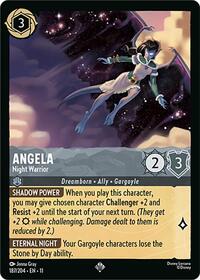 Angela - Night WarriorWinterspell · 187/204$11.40
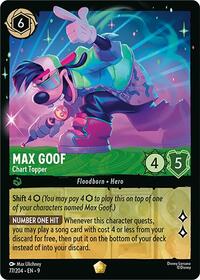 Max Goof - Chart TopperFabled · 77/204$41.07
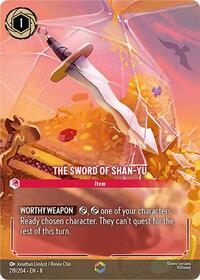 The Sword of Shan Yu (Enchanted)Reign of Jafar · 219/204$46.50
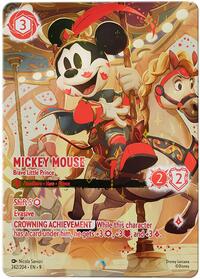 Mickey Mouse - Brave Little Prince (Iconic)Fabled · 242/204$3,875.00
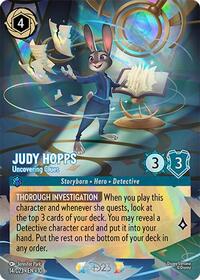 Judy Hopps - Uncovering CluesD23 Promos · 14$45.73
Enchanted, Epic and Iconic: the special versions
These three rarities are not new cards in the game sense: they are special versions, with new art, of cards that also exist at a regular rarity. That is why the same character can sit at very different prices.
Enchanted cards have been part of Lorcana since The First Chapter. Each set has a limited number of them, and they are the classic chase cards: borderless, full-art and always foil.
Epic and Iconic arrived with Fabled, the ninth set, in September 2025. Ravensburger places Epic between Legendary and Enchanted, and says Epics turn up more often than Enchanteds. Iconic sits above everything: just two per set, far less common than Enchanted cards. Fabled's Iconics were Mickey Mouse - Brave Little Prince and Minnie Mouse - Sweetheart Princess, and every set since has added its own pair.
For the prices these cards reach today, see the most valuable Lorcana cards right now.
Foil and cold foil
Almost every Lorcana card also exists as a foil, and each booster holds one foil card of any rarity. Lorcana's standard foil is a cold foil: instead of an all-over rainbow shine, the foil is applied to selected parts of the card and gives it a metallic sheen. Enchanted, Epic and Iconic cards have their own foil treatments on top of that.
TCGplayer prices the normal and the cold foil version of a card separately, and in our data the foil is worth more for nearly every card. Before you look a card up, tilt it under a light: if parts of the art shine like metal, you have the foil.
How to read a Lorcana card
- Ink cost (top left): what you pay to play the card. If the number is surrounded by the decorative inkwell symbol, the card is inkable, which means it can be placed face down in your inkwell as a resource. If the cost sits in a plain hexagon, it can't.
- Inks: the game has six inks, Amber, Amethyst, Emerald, Ruby, Sapphire and Steel, and a deck can use no more than two of them.
- Name and subtitle: character cards pair a name with a subtitle, as in Elsa - Spirit of Winter. Different subtitles are different cards.
- Strength, willpower and lore: on characters, strength is the damage dealt in a challenge, willpower (the shield) is how much damage the character can take, and the lore symbols are the points it collects when it quests. The first player to 20 lore wins.
- Rarity symbol: bottom centre, as described above.
- Bottom left corner: the artist's name, the collector number (for example 154/204), the language (EN for English) and the set number: 1 for The First Chapter, 3 for Into the Inklands, 9 for Fabled, 14 for Hyperia City.
A collector number above the set total, such as 207/204 or 242/204, belongs to an Enchanted, Epic or Iconic card. Promos may use a P in their number, but they still carry the number of the set the card was first printed in.
Same name, different card
Fabled reprinted cards from the first sets, which is a good reason to always check the set number. Elsa - Spirit of Winter appears in Fabled as a Legendary numbered 43/204, at $28.29, while the Enchanted Elsa - Spirit of Winter from The First Chapter is numbered 207/204 and sells for $952.84. Same name, same character, two very different prices.
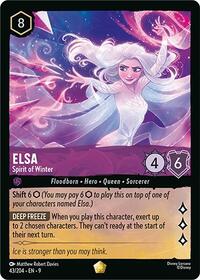 Elsa - Spirit of WinterFabled · 43/204$28.29
 Elsa - Spirit of Winter (Enchanted)The First Chapter · 207/204$952.84
How to price a Lorcana card
- Read the bottom left corner: set number and collector number tell you exactly which card you have.
- Check the rarity symbol and the finish: normal or foil, and whether it is an Enchanted, Epic or Iconic.
- Look it up by set on our Disney Lorcana hub, which lists every set with its most valuable cards and the latest price moves. The newest set is Hyperia City.
- Adjust for condition: the market price is for a clean, ungraded copy. Scratches, whitened edges or a bend lower it, and graded copies have a market of their own.
In Europe, Cardmarket is the main marketplace for single cards, and its euro prices can differ from TCGplayer's dollar prices.
Scan it with your phone
The Foilmon app recognises Disney Lorcana cards by reading the card's name and set number with the camera, so keep the name and the bottom left corner sharp and free of glare. It shows the TCGplayer price of the normal and the foil version, adds the card to your collection and updates its total value every day. The same app recognises Pokémon, One Piece, Magic: The Gathering and Yu-Gi-Oh! cards too.
Frequently asked questions
What is the rarest rarity in Disney Lorcana?
Iconic. Each set since Fabled has only two Iconic cards, and Ravensburger describes them as far less common than Enchanted cards.
What is the difference between Enchanted and Epic?
Both are special foil versions of existing cards with new art and numbers above the set total. Enchanted cards are borderless and rarer; Epic cards, added with Fabled, have frameless art and tinted text and turn up more often.
Where is the set number on a Lorcana card?
In the bottom left corner, after the artist's name, the collector number and the language. A card marked 154/204, EN and 3 is card 154 of set 3, Into the Inklands, in English.
How can I tell if a Lorcana card is inkable?
Look at the ink cost in the top left corner. If it is surrounded by the decorative inkwell symbol, the card can go into your inkwell; if the cost sits in a plain hexagon, it can't.
Are foil Lorcana cards worth more?
Almost always. TCGplayer prices the normal and the cold foil version of each card separately, and the foil is the more expensive one for nearly every card. Check the price of the exact finish you have.
Sources
- The next chapter of Disney Lorcana: new rarities and set announcements (disneylorcana.com, May 2025)
- Stunning new rarities: Epic and Iconic cards (disneylorcana.com, August 2025)
- Amber ink (disneylorcana.com)
- Disney Lorcana Card Rarity Explained (Tabletop Gaming)
- Disney Lorcana rarity symbols (Wargamer, updated 17 January 2024)
- Disney Lorcana rarities explained (Dexerto)
- Disney Lorcana reveals its cold foil treatment (ComicBook.com, 25 April 2023)
- How to Tell Which Disney Lorcana Set a Card Is From (Card Gamer)
- How to play Disney Lorcana (Card Gamer)
- Inkable vs Uninkable: Building Your Inkwell (Geeky Domain)
Related guides
One Piece, Lorcana, Magic & Yu-Gi-Oh!The most valuable Disney Lorcana cards right nowThe most valuable Disney Lorcana cards right now, ranked by TCGplayer market price and updated daily: Iconic, Enchanted and rare promo cards explained. One Piece, Lorcana, Magic & Yu-Gi-Oh!One Piece card rarities explainedOne Piece card rarities explained: C, UC, R, SR, SEC, L, SP, TR and promos, plus parallels and Manga Rares, and how to identify and price your exact card.
 Collecting basicsPokémon card rarity symbols: what every mark meansPokémon card rarity symbols explained: circle, diamond, star, every star tier up to Mega Hyper Rare, and Japanese codes such as AR, SR and SAR.
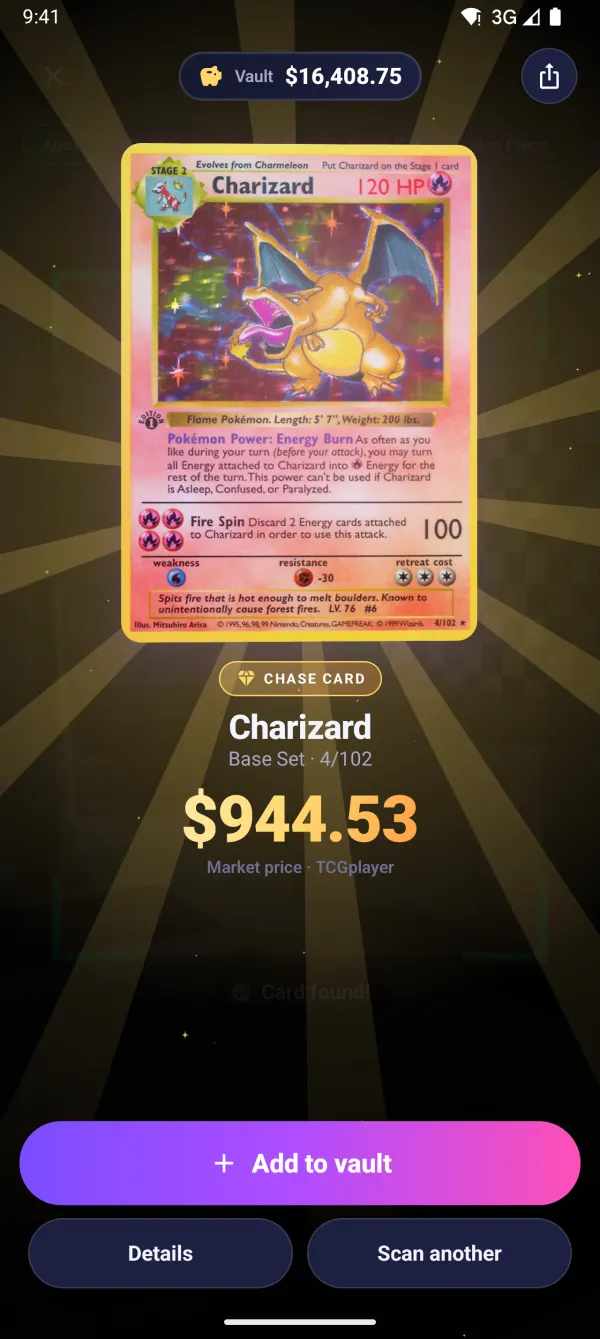 Scanning cardsHow to scan Pokémon cards with your phone and see their valueHow to scan Pokémon cards with your phone and see their value: step by step, tips for holos and sleeves, Japanese cards and batch-scanning a binder.